

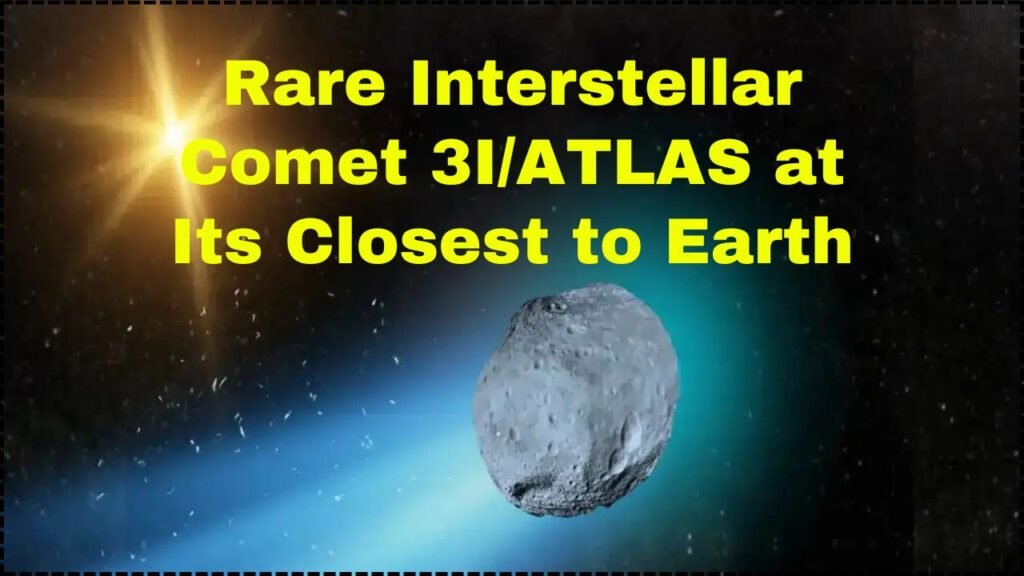
The interstellar comet 3I/ATLAS reached its closest point to Earth in mid-December, giving astronomers a short but valuable chance to study only the third known object confirmed to have entered the solar system from interstellar space.
Table of Contents
What Is Interstellar Comet 3I/ATLAS?
Interstellar comet 3I/ATLAS was first detected earlier this year by the Asteroid Terrestrial-impact Last Alert System (ATLAS), a NASA-funded network of robotic telescopes designed to identify fast-moving objects that could pose a threat to Earth.
Initial observations showed the object moving at unusually high speed and along a sharply angled trajectory. Within days, independent teams confirmed that the comet’s orbit was hyperbolic, meaning it was not gravitationally bound to the Sun.
“This orbit tells us the object did not originate in our solar system,” said Dr. Paul Chodas, director of NASA’s Center for Near-Earth Object Studies, in a statement released by the agency. “It is a visitor from another star system.”
Astronomers officially designated the object as 3I/ATLAS, making it the third confirmed interstellar object ever identified, following 1I/‘Oumuamua in 2017 and 2I/Borisov in 2019. The naming convention reflects its status as the third “interstellar” object (“I”) cataloged by the International Astronomical Union.
Unlike ‘Oumuamua, whose nature sparked debate over whether it was an asteroid or comet, 3I/ATLAS quickly showed signs of a faint coma—an envelope of gas and dust—indicating that it is indeed a comet.
When and How Close Did 3I/ATLAS Come?
Closest Approach Explained
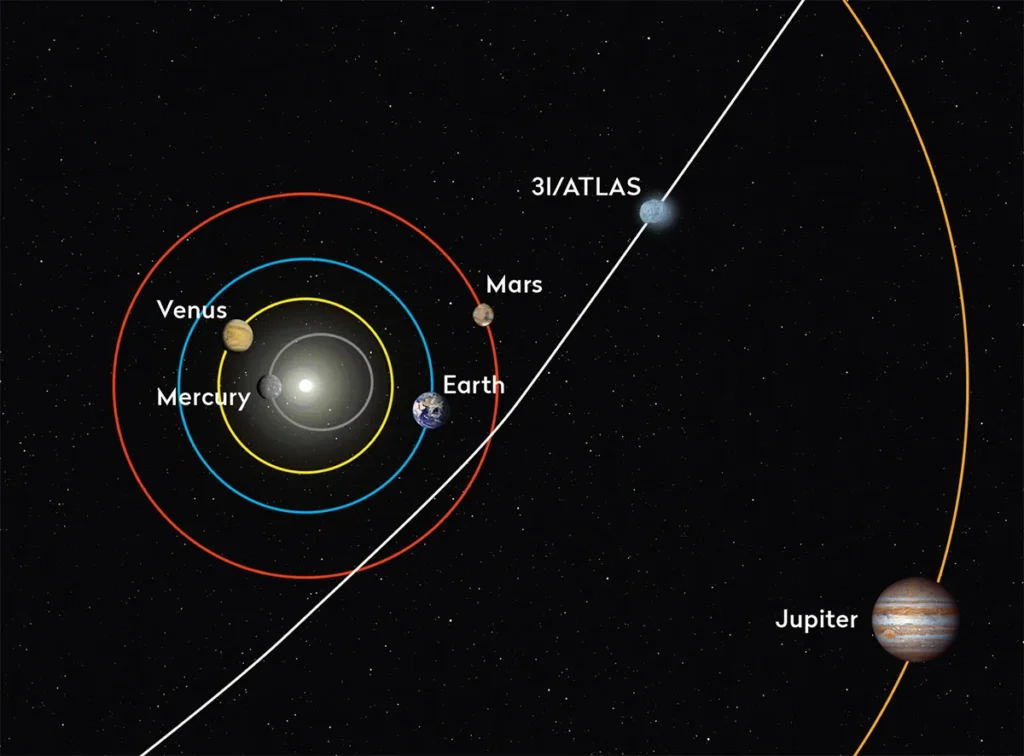
The closest approach of interstellar comet 3I/ATLAS occurred around December 19, when it passed roughly 270 million kilometers (168 million miles) from Earth. That distance is nearly twice the average distance between Earth and the Sun.
According to orbital calculations published by NASA’s Jet Propulsion Laboratory, the comet remained well outside Earth’s orbital neighborhood and never entered the inner planetary region that would raise safety concerns.
“This was never a near-miss in planetary terms,” said Dr. Davide Farnocchia, a navigation engineer at JPL. “But it was close enough to allow detailed observation with powerful telescopes across the globe.”
At the time of closest approach, the comet was already outbound, having passed perihelion—its closest point to the Sun—weeks earlier. Scientists say that timing limited how bright the object became, contributing to its faint appearance from Earth.

Best Viewing Window for Observers
Visibility From Earth
Despite widespread public interest, astronomers cautioned that 3I/ATLAS was never visible to the naked eye. At its brightest, it reached only a faint magnitude, making it accessible primarily to research-grade telescopes and experienced amateur astronomers using large apertures.
The optimal viewing window occurred in the early morning hours before dawn during mid-December. From Earth, the comet appeared to move slowly against the background stars of the constellation Leo, passing near the bright star Regulus.
Sky charts published by the Royal Astronomical Society and other observatories guided observers attempting to locate the comet. Even under ideal conditions, it appeared as a dim, diffuse smudge rather than a dramatic object with a visible tail.
“Even for experienced observers, this was a challenging target,” said Dr. Meg Schwamb, an astronomer at Queen’s University Belfast. “Most of the science is coming from professional observatories rather than backyard telescopes.”
Cloud cover and light pollution further limited visibility for many regions, reinforcing the importance of coordinated international observation campaigns.
Why 3I/ATLAS Matters to Scientists
A Rare Scientific Opportunity
Interstellar comets provide scientists with direct samples—albeit remote ones—of material formed around other stars. Unlike planets or moons, which are difficult to study beyond the solar system, these objects carry physical evidence from distant stellar nurseries.
Preliminary spectroscopic data collected from observatories in Chile and Hawaii suggest that 3I/ATLAS contains water ice and carbon-based compounds, according to early findings shared by researchers affiliated with the European Space Agency.
“These are the same basic ingredients we see in comets from our own solar system,” said Dr. Alan Fitzsimmons, professor of astronomy at Queen’s University Belfast. “That similarity is intriguing and may suggest that planet formation processes are common throughout the galaxy.”
However, scientists caution that subtle differences in composition—still under analysis—could reveal important clues about temperature, radiation exposure, and chemical conditions in other star systems.
Interstellar comets also help astronomers refine models of how frequently material is exchanged between star systems. Some researchers believe trillions of such objects may drift through the Milky Way at any given time, though only a tiny fraction pass close enough to be detected.
How Astronomers Observed the Comet
Observing interstellar comet 3I/ATLAS required rapid international coordination. Once its interstellar nature was confirmed, observatories across multiple continents prioritized follow-up observations.
Major facilities in Hawaii, Chile, the Canary Islands, and Australia tracked the comet’s brightness, motion, and spectral signature. NASA also scheduled limited observations using the Hubble Space Telescope to refine estimates of the comet’s size and activity level.
“Space-based telescopes are especially valuable because they avoid atmospheric distortion,” said a NASA spokesperson. “They allow us to detect faint gas emissions that are otherwise difficult to observe.”
In addition to professional research, public engagement played a role. The Virtual Telescope Project, based in Italy, streamed live views of the comet during its closest approach, enabling viewers worldwide to watch the object in real time despite its faintness.
Historical Context: How Rare Is This Event?
Before 2017, astronomers had never definitively identified an interstellar object passing through the solar system. The discovery of ‘Oumuamua challenged existing assumptions and prompted new survey strategies.
The detection of 2I/Borisov two years later confirmed that such objects were not anomalies. With 3I/ATLAS, scientists say a pattern is emerging—not of frequent encounters, but of increasing detection capability.
“These discoveries are less about the universe changing and more about our technology improving,” said Dr. Karen Meech, an astronomer involved in earlier interstellar object studies.
New survey telescopes, including the upcoming Vera C. Rubin Observatory in Chile, are expected to dramatically increase the detection rate of faint, fast-moving objects in the coming decade.
What Happens Next?
After its closest pass, interstellar comet 3I/ATLAS is now receding from the inner solar system, gradually dimming as it travels back into interstellar space. Astronomers expect it will remain observable to large telescopes for several more months before fading beyond detection limits.
Data collected during this period will be analyzed for years, contributing to broader studies of comet chemistry, stellar evolution, and galactic dynamics.
“This object will be gone forever,” Dr. Schwamb said. “But the data we collect now will help prepare us for the next interstellar visitor.”
FAQ
Is interstellar comet 3I/ATLAS dangerous?
No. According to NASA, the comet passed at a safe distance and posed no threat to Earth or other planets.
Can it still be seen?
Only with large professional telescopes. It is now fading rapidly and is no longer well positioned for amateur observation.
Why are interstellar objects so difficult to detect?
They are small, move extremely fast, and do not reflect much sunlight, making them visible only when they pass relatively close to the Sun and Earth.
Will more interstellar comets be found?
Astronomers expect discoveries to increase as new survey telescopes come online and sky-monitoring technology improves.
Final Note
Scientists say discoveries like interstellar comet 3I/ATLAS mark the beginning of a new era in observational astronomy. Each object provides a fleeting but invaluable opportunity to study material formed beyond the solar system, expanding understanding of how planets and stars form across the galaxy.