

Daylight Saving Time 2026 will end in the United States on Sunday, Nov. 1, when clocks are set back one hour at 2 a.m. local time. The annual change marks the return to standard time, affects most U.S. states, and continues a long-running national debate over whether seasonal clock changes still serve an economic, social, or public health purpose.
Table of Contents
Daylight Saving Time 2026
| Key Fact | Detail |
|---|---|
| DST End Date | Sunday, Nov. 1, 2026 |
| Time of Change | 2:00 a.m. local time |
| Clocks Adjusted | Set back one hour |
| Official Website | timeanddate.com |
What Happens When Daylight Saving Time Ends
When Daylight Saving Time ends, most Americans will turn their clocks back from 2 a.m. to 1 a.m., effectively repeating one hour overnight. The change provides an extra hour of sleep but also brings earlier sunsets, a shift that becomes increasingly noticeable as winter approaches.
Federal timekeeping rules specify the 2 a.m. transition to minimize disruption to commerce, transportation, and overnight work schedules. According to the National Institute of Standards and Technology (NIST), the timing reduces the risk of overlapping dates and confusion in recordkeeping systems.
For many workers, particularly those in healthcare, transportation, and emergency services, the repeated hour can create logistical challenges. Hospitals and airlines typically rely on coordinated universal time (UTC) systems to avoid scheduling conflicts, while payroll systems must account for the additional hour worked by overnight staff.
Where Daylight Saving Time 2026 Applies—and Where It Does Not
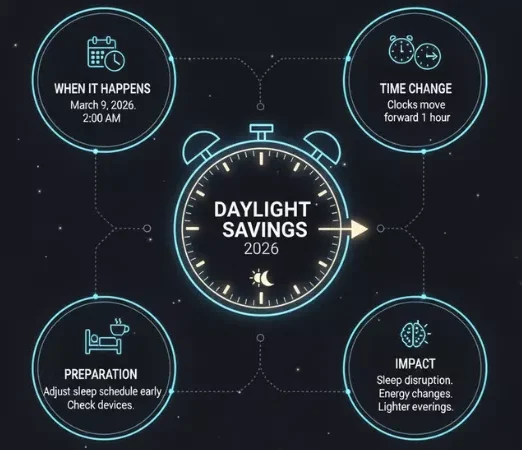
Daylight Saving Time 2026 will be observed by most U.S. states, but longstanding exceptions remain. Arizona, except for the Navajo Nation, and Hawaii stay on standard time year-round. Several U.S. territories, including Puerto Rico, Guam, American Samoa, and the U.S. Virgin Islands, also do not observe DST.
The U.S. Department of Transportation (DOT) oversees time zones and DST under federal law. While states may opt out of Daylight Saving Time entirely, they cannot adopt permanent daylight time without congressional approval.
Geography plays a major role in these decisions. Hawaii’s proximity to the equator means daylight hours remain relatively consistent year-round, reducing the practical benefits of clock changes. Arizona officials have long argued that extended evening daylight would increase energy use due to air conditioning demand.
Why the Clock Change Persists
The modern U.S. system of Daylight Saving Time is rooted in the Uniform Time Act of 1966, which sought to standardize a patchwork of local practices that had emerged during World War II. Congress later extended DST in 2007, lengthening the period to begin in March and end in November.
Supporters historically claimed DST conserved energy, reduced traffic accidents, and encouraged retail activity by providing more evening daylight. However, many of those assumptions have been challenged by contemporary research.
A study published by the National Bureau of Economic Research found that DST can actually increase residential energy consumption in some regions. Meanwhile, the American Academy of Sleep Medicine has repeatedly warned that clock changes disrupt circadian rhythms and may contribute to short-term increases in heart attacks, strokes, and workplace injuries.
“Human biology does not adjust instantly to sudden shifts in time,” said Dr. M. A. Grandner, director of the Sleep and Health Research Program at the University of Arizona. “Even small disruptions can have measurable effects on health and performance.”

Economic and Public Safety Impacts
Beyond health concerns, Daylight Saving Time has measurable economic and safety implications. Insurance industry data analyzed by the Insurance Institute for Highway Safety shows a short-term increase in morning traffic accidents following the fall clock change, as drivers adjust to darker conditions.
Retail and leisure industries, however, have historically favored DST, arguing that extended evening daylight boosts consumer spending. The U.S. Chamber of Commerce has previously supported longer daylight hours, citing benefits for small businesses.
Public safety agencies take a more cautious view. The National Safety Council has warned that darker evenings during standard time may increase pedestrian fatalities, particularly among children traveling after school hours during winter months.
How Technology Handles the Time Change
Modern technology has reduced some of the inconvenience associated with Daylight Saving Time. Smartphones, computers, and connected devices automatically adjust clocks based on network time protocols maintained by NIST and international timekeeping bodies.
Still, experts caution that manual systems and older infrastructure remain vulnerable to errors. Financial markets, hospitals, and utilities conduct extensive testing ahead of clock changes to ensure accurate timestamping.
“In highly automated environments, even a one-hour discrepancy can create cascading errors,” said a senior systems engineer at a major U.S. utility, who spoke on condition of anonymity due to security policies.
International Perspective: How the U.S. Compares
The United States is far from alone in observing Daylight Saving Time, but global practices vary widely. Most European countries shift clocks on the last Sunday in March and October, while countries near the equator typically avoid DST altogether.
The European Union voted in 2019 to allow member states to abandon seasonal clock changes, though implementation has been delayed amid political and logistical disagreements. If enacted, Europe could see neighboring countries operating on different permanent times.
Countries such as Japan, China, and India do not observe DST, citing limited benefits and administrative complexity. Russia abandoned DST in 2014, opting for permanent standard time after public complaints about dark winter mornings.
Ongoing Debate Over the Future of Daylight Saving Time
Efforts to end clock changes in the United States have gained bipartisan attention. The Sunshine Protection Act, which proposes permanent daylight time, has passed the Senate by unanimous consent in previous sessions but stalled in the House of Representatives.
Supporters argue that eliminating clock changes would improve health outcomes and simplify scheduling. Opponents, including some sleep scientists, counter that permanent daylight time could lead to unsafe morning darkness during winter months, particularly in northern states.
“Permanent standard time aligns best with human circadian biology,” said Dr. Beth Ann Malow, a neurologist at Vanderbilt University Medical Center, during congressional testimony.
As of late 2025, no legislation had been enacted to alter the Daylight Saving Time 2026 schedule.
FAQ
When do clocks fall back for Daylight Saving Time 2026?
Clocks fall back one hour at 2 a.m. local time on Sunday, Nov. 1, 2026.
Does every U.S. state observe Daylight Saving Time?
No. Hawaii and most of Arizona do not observe DST.
Is Daylight Saving Time ending permanently in 2026?
No. There is no federal law currently scheduled to end or change DST nationwide in 2026.
Will airlines, banks, and stock markets be affected?
Major institutions adjust schedules in advance and rely on coordinated time systems to avoid disruptions.
What Comes Next
Unless Congress acts, Americans will continue observing the established schedule, with clocks moving forward again on March 8, 2026. Federal agencies continue to study the effects of seasonal time changes, but for now, the familiar ritual of turning clocks back remains part of the national calendar.